
Here we answer five frequently asked questions about what Giethoorn actually is. Factual, clear and based on local knowledge from the village itself.
🅠 1. Why is Giethoorn called the “Venice of the North” (Dutch Venice)?
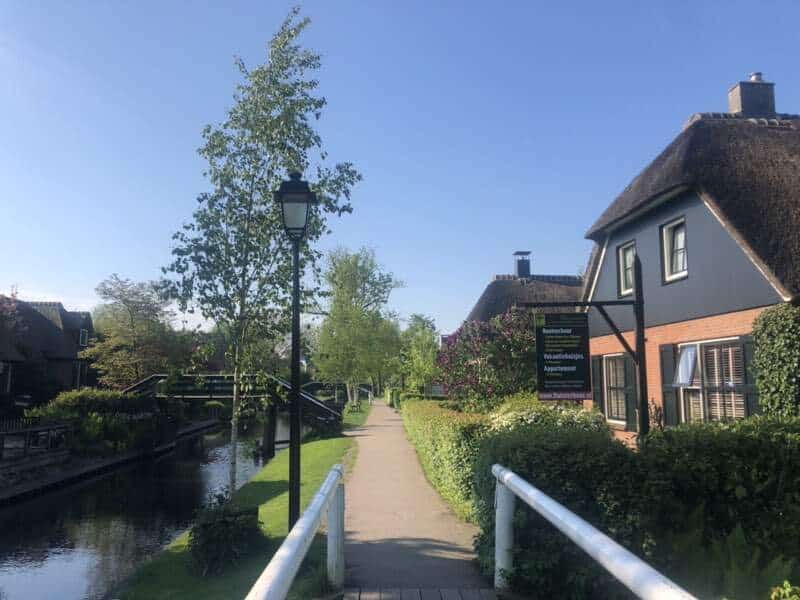
Giethoorn is given this nickname because of its unique village structure, in which water plays the leading role. In the historic village centre, a canal several kilometres long runs between the farmhouses. Many properties are partly accessible only via wooden bridges, and car traffic is almost entirely absent. As in Venice, people move around on foot or by water, but in a small-scale, green and rural setting. Giethoorn is not a copy of Venice, but a distinctive Dutch water village. Due to its abundant natural scenery, the village is nowadays also referred to as “the Green Venice”.
🅠 2. How many people live in Giethoorn?
Giethoorn has approximately 2,900 inhabitants. Despite its worldwide fame, Giethoorn is relatively small in terms of population. The total surface area is about 38.64 km², of which 32.74 km² is land and 5.9 km² is water.
🅠 3. Where exactly is Giethoorn located?
Giethoorn is situated in the northern part of the province of Overijssel, in the municipality of Steenwijkerland, about 9 kilometres southwest of Steenwijk. The village directly borders National Park Weerribben-Wieden, one of the largest contiguous lowland peat marsh areas in north-western Europe. This vast nature reserve consists of lakes, reed beds and marshland. Its location makes Giethoorn not only a village, but also a gateway to nature. From Giethoorn, you can easily enter the national park by boat or by bicycle.
🅠 4. Is Giethoorn accessible all year round?
Yes. Giethoorn can be visited throughout the year and welcomes visitors in all four seasons. However, the experience differs by season. In spring and summer, the village is lively, with boating, terraces and long days on the water. In autumn, it becomes quieter and more atmospheric, with warm colours along the canals and in the reed beds. In winter, Giethoorn is often calm but also highly photogenic. Please note that not all facilities are open daily during the winter months.
🅠 5. What makes Giethoorn different from other water villages?
Giethoorn originated from peat extraction, during which water literally shaped the structure of the village. This resulted in a characteristic ribbon-shaped development along the Dorpsgracht, with houses close to the water and along narrow footpaths and cycle paths. Numerous small bridges connect both sides, while the transition from village centre to surrounding nature is almost seamless. This makes Giethoorn particularly photogenic and remarkably green. In addition, visitors can easily steer their own boat on shallow waters, allowing them to experience the village from within. Even practical matters are handled differently here: household waste is collected by boat, and the fire brigade operates a fire-fighting boat.
Compiled by the local editorial team of Giethoorn.AI.
Last updated: January 2026.
This is the third article in the “Questions & Answers about Giethoorn” series.
0 reacties